How Operating Temperature Affects Lithium-Ion Batteries?
We've seen countless batteries fail prematurely, and when we investigate the root cause, temperature abuse tops the list. Most users don't realize their battery is silently dying from temperature stress until it's too late.
Operating temperature dramatically affects lithium-ion battery performance and lifespan. High temperatures accelerate chemical degradation and capacity fade, while low temperatures reduce charge efficiency and usable capacity. Maintaining batteries between 15°C-25°C can double their service life.
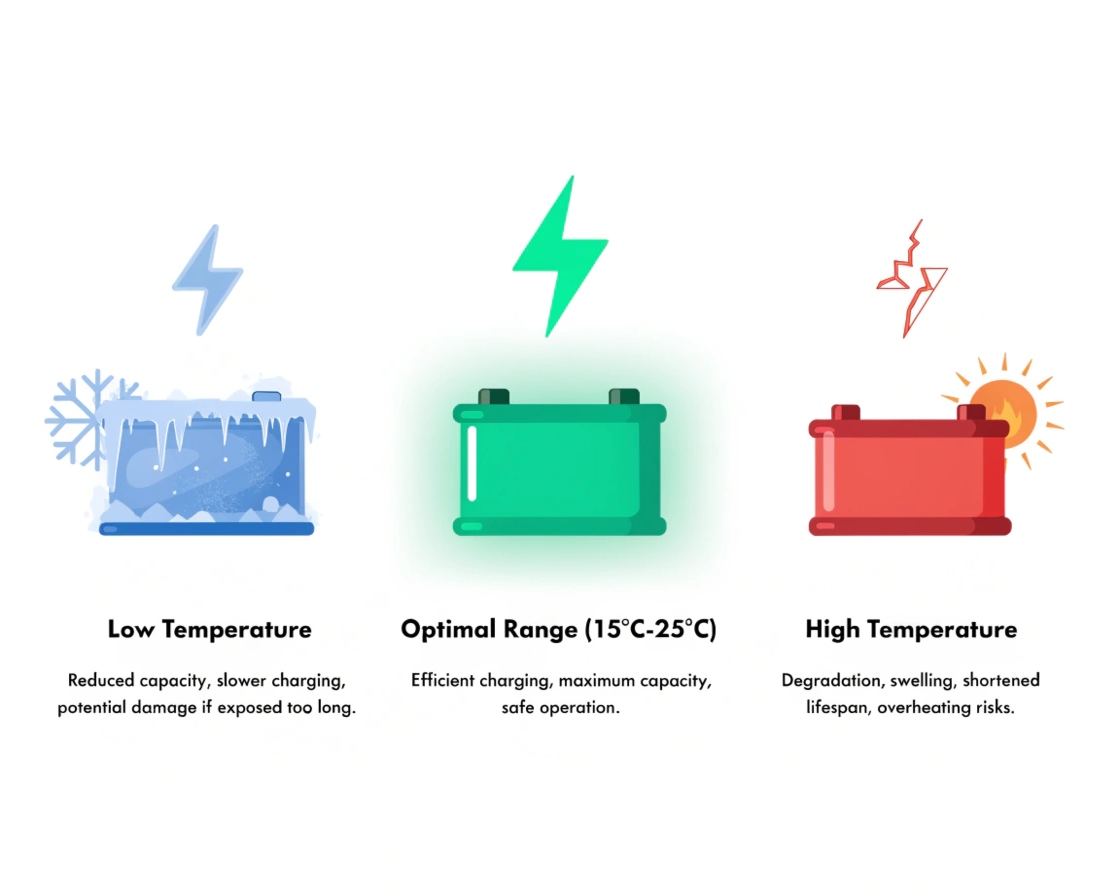
Temperature management isn't optional for lithium batteries—it's essential. Let's explore how temperature affects every aspect of battery performance and what you can do about it.
How is Battery Capacity Affected by Temperature?
When we first started testing batteries in different climates, the capacity variations shocked us. The same battery could perform like completely different products depending on ambient temperature.
Battery capacity decreases significantly outside the optimal temperature range of 15°C-25°C. At 0°C, usable capacity drops to 70-80% of rated capacity. At -20°C, capacity can fall below 50%. At 45°C, capacity temporarily increases but accelerates long-term degradation.
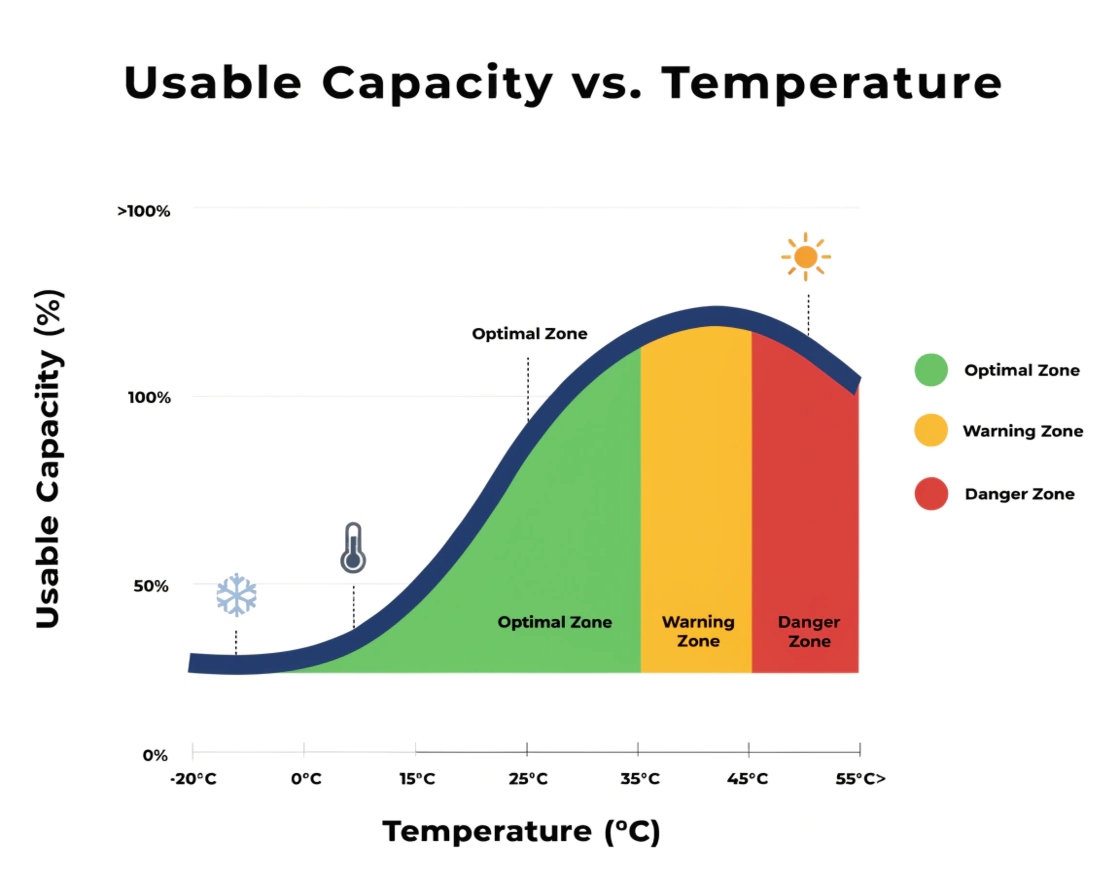
Understanding these capacity changes helps you design systems appropriately:
Capacity Performance by Temperature
| Temperature | Available Capacity | Performance Notes |
|---|---|---|
| -20°C (-4°F) | 40-60% | Severely reduced |
| -10°C (14°F) | 60-70% | Significantly limited |
| 0°C (32°F) | 70-80% | Noticeably reduced |
| 15°C-25°C (59°F-77°F) | 95-100% | Optimal range |
| 35°C (95°F) | 100-105% | Slight increase |
| 45°C (113°F) | 100-110% | Temporary boost |
| 55°C+ (131°F+) | Variable | Rapid degradation |
Why Temperature Affects Capacity
The chemistry inside batteries operates through ion movement. Temperature directly affects this movement speed:
Cold Temperature Effects
- Electrolyte becomes more viscous
- Ionic conductivity decreases
- Lithium-ion mobility slows dramatically
- Internal resistance increases
- Voltage drops under load faster
Hot Temperature Effects
- Chemical reactions accelerate
- Ion mobility increases temporarily
- Side reactions occur more readily
- Internal resistance initially decreases
- Degradation processes speed up
Practical Implications
If you operate a 100Ah battery at -10°C, you might only access 60-70Ah of usable capacity. The remaining capacity isn't permanently lost—it returns when temperature rises. However, repeatedly cycling batteries at temperature extremes causes permanent capacity loss over time1.
Can Cold Temperatures Damage Lithium Batteries?
We often hear people say lithium batteries are maintenance-free and temperature-tolerant. This misconception has destroyed more batteries than we can count.
Cold temperatures can permanently damage lithium batteries, especially during charging. Charging below 0°C causes lithium plating on the anode, creating irreversible capacity loss and potential safety hazards. Storage at low temperatures is less harmful but still reduces performance.
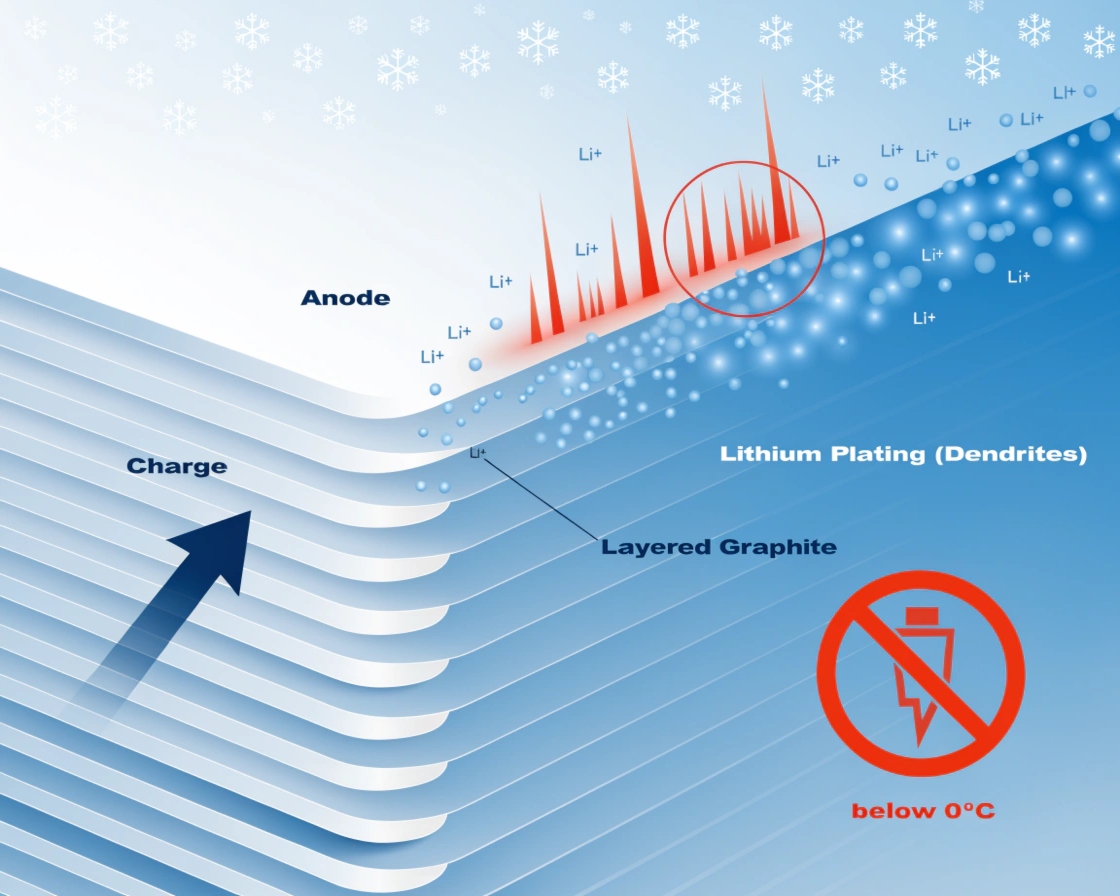
Let us explain the different types of cold-weather damage:
Charging Damage (Most Critical)
Charging lithium batteries in cold conditions represents the highest risk. When you charge below 0°C:
The Lithium Plating Problem
- Lithium ions cannot intercalate into graphite quickly enough
- Metallic lithium deposits on anode surface
- Plated lithium becomes irreversible capacity loss
- Dendrites may form over multiple cycles
- Internal short circuit risk increases
Charge Temperature Limits
| Temperature | Charging Safety | Recommended Action |
|---|---|---|
| Below -10°C | Extremely dangerous | Never charge |
| -10°C to 0°C | High risk | Warm battery first |
| 0°C to 5°C | Moderate risk | Reduced current only |
| 5°C to 15°C | Low risk | 0.2C maximum |
| 15°C to 25°C | Safe | Normal charging |
| 25°C to 45°C | Safe with monitoring | Normal charging |
Discharge Damage (Lower Risk)
Discharging at low temperatures is safer than charging but still causes issues:
- Reduced power output capability
- Higher voltage sag under load
- Increased internal resistance
- Potential over-discharge if voltage cutoff isn't adjusted
- Mechanical stress from repeated expansion/contraction
Storage Damage (Minimal Risk)
Cold storage affects batteries less severely:
- Self-discharge rate decreases significantly
- Chemical degradation slows down
- No lithium plating risk without current flow
- Capacity recovers when warmed properly
Real-World Cold Damage Examples
From our experience, We've seen:
- EV batteries losing 30% capacity after one winter of cold charging
- Power tool batteries failing after garage storage and cold charging
- Solar batteries damaged by dawn charging in freezing conditions
- Smartphone batteries swelling from cold-weather fast charging
What is the 40 80 Rule for Lithium Batteries?
This rule gets mentioned frequently, but we find many users misunderstand its purpose and application. It's not just about state of charge—temperature plays a crucial role.
The 40-80 rule recommends keeping lithium batteries between 40% and 80% state of charge for optimal longevity, combined with storage temperatures between 15°C-25°C. This practice can extend battery life by 2-3 times compared to full charge storage at elevated temperatures.
Understanding this rule requires looking at both charge state and temperature together:
State of Charge Component
Why Not Store at 100%?
- High voltage accelerates cathode degradation
- Electrolyte oxidation increases
- Side reactions occur more readily
- SEI layer grows faster
- Capacity fade accelerates significantly
Why Not Store Below 40%?
- Risk of over-discharge during long storage
- Anode copper dissolution may occur
- Difficult to recover from deep discharge
- Potential permanent capacity loss
Temperature Component (Often Overlooked)
| Storage Condition | Capacity Loss per Year | Relative Aging Rate |
|---|---|---|
| 40% SOC at 0°C | 2% | 1× (baseline) |
| 40% SOC at 25°C | 4% | 2× |
| 100% SOC at 25°C | 20% | 10× |
| 100% SOC at 40°C | 35% | 17.5× |
| 100% SOC at 60°C | 60%+ | 30×+ |
Practical Implementation
For maximum battery life, combine charge and temperature management:
Daily Use Strategy
- Charge to 80% for regular use
- Discharge to 40% when possible
- Avoid keeping battery at 100% for extended periods
- Don't let battery sit below 20% for days
Long-Term Storage Strategy
- Charge to 50-60% before storage
- Store in cool location (15°C-20°C ideal)
- Check and recharge every 3-6 months
- Avoid hot garages or freezing sheds
The Mathematics Behind the Rule
The combination of high state of charge and high temperature creates exponential degradation2. A battery stored at 100% SOC at 40°C ages nearly 18 times faster than one stored at 40% SOC at 0°C. This isn't linear—it's multiplicative.
At What Temperature Do Lithium Batteries Become Unstable?
Safety concerns around lithium batteries often focus on temperature extremes. We've investigated several battery incidents, and temperature abuse featured prominently in most cases.
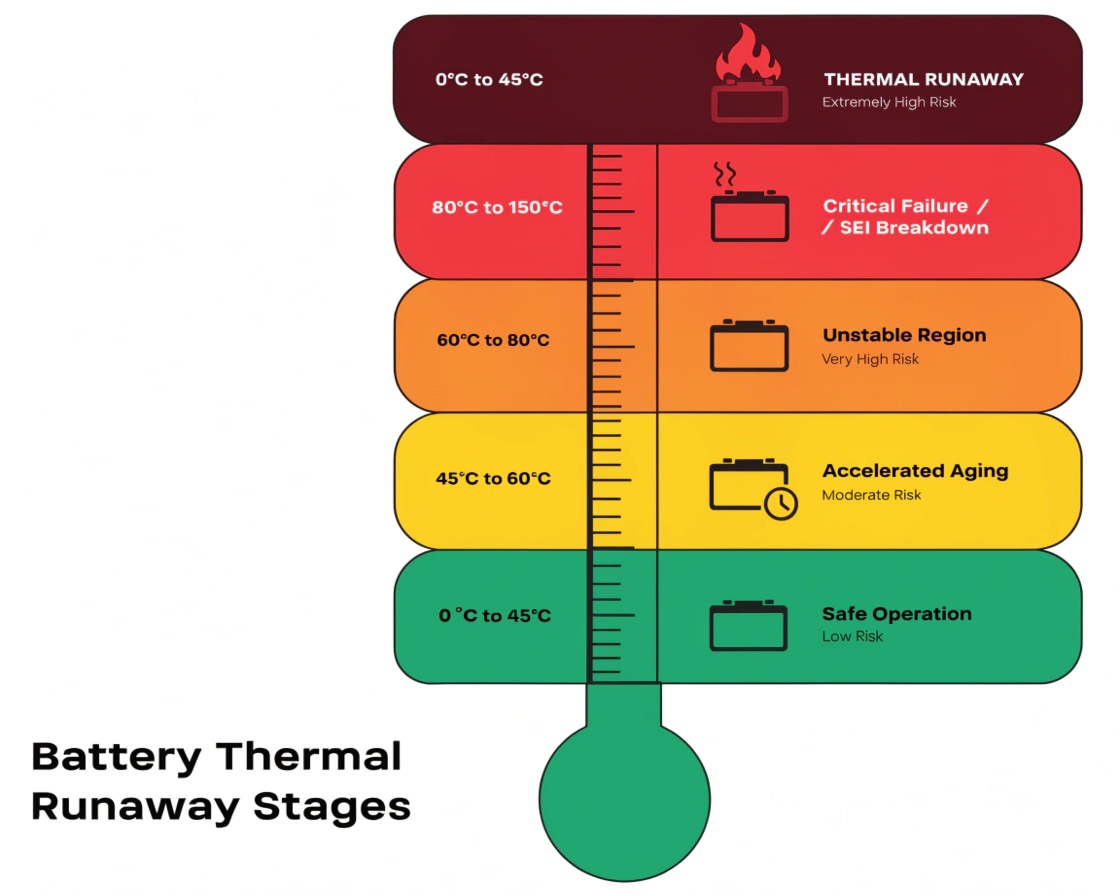
Lithium batteries become unstable above 60°C during normal operation, with critical failure risk above 80°C. Thermal runaway typically initiates between 80°C-150°C depending on cell chemistry, triggering a self-sustaining reaction that can reach 400°C-800°C.
Thermal runaway progression
Understanding temperature-related safety risks helps prevent catastrophic failures:
Temperature Safety Zones
| Temperature Range | Status | Risk Level |
|---|---|---|
| -40°C to 0°C | Reduced performance | Low (discharge only) |
| 0°C to 45°C | Normal operation | Minimal |
| 45°C to 60°C | Accelerated aging | Moderate |
| 60°C to 80°C | Unstable region | High |
| 80°C to 150°C | Critical zone | Extreme |
| Above 150°C | Thermal runaway | Catastrophic |
Thermal Runaway Process
When batteries exceed critical temperature, a chain reaction begins:
Stage 1: Initial Heating (60°C-80°C)
- Increased internal resistance
- Faster chemical reactions
- Gas generation begins
- Internal pressure rises
Stage 2: SEI Breakdown (80°C-120°C)
- Solid electrolyte interface decomposes
- Fresh lithium exposed to electrolyte
- Exothermic reactions accelerate
- Temperature rise becomes self-sustaining
Stage 3: Separator Melting (120°C-150°C)
- Polymer separator begins melting
- Internal short circuits may occur
- Massive heat generation
- Gas venting or rupture
Stage 4: Full Thermal Runaway (150°C+)
- Cathode material breaks down
- Oxygen released feeds fire
- Temperature spikes to 400°C-800°C
- Fire, explosion, or violent venting
Chemistry-Specific Thresholds
Different lithium chemistries have varying thermal stability:
| Chemistry | Thermal Runaway Onset | Safety Rating |
|---|---|---|
| LiFePO4 | 180°C-250°C | Excellent |
| NMC | 150°C-200°C | Good |
| NCA | 140°C-180°C | Moderate |
| LCO | 130°C-150°C | Lower |
Prevention Strategies
Temperature management prevents instability:
Active Cooling Systems
- Maintain cells below 45°C during operation
- Provide emergency cooling during fast charging
- Monitor temperature at multiple points
- Shutdown charging if limits exceeded
Passive Safety Features
- Thermal fuses disconnect at set temperature
- Pressure relief valves prevent explosion
- Current interrupt devices stop flow
- Thermal insulation between cells
System-Level Protection
- BMS temperature monitoring
- Derating power output at high temperature
- Forced cooling activation
- Emergency shutdown protocols
Warning Signs of Temperature Problems
From our field experience, watch for:
- Battery feeling hot to touch (above 45°C)
- Swelling or bulging case
- Unusual odors during charging
- Reduced runtime despite full charge
- BMS frequently limiting current
Conclusion
Operating temperature profoundly impacts lithium-ion battery performance, safety, and longevity. Maintaining batteries between 15°C-25°C, avoiding cold-weather charging, following the 40-80 rule, and preventing temperatures above 60°C can extend battery life by 2-3 times while ensuring safe operation.
-
"Capacity Fade Mechanisms and Side Reactions in Lithium-Ion Batteries", https://www.academia.edu/8634626/Capacity_Fade_Mechanisms_and_Side_Reactions_in_Lithium_Ion_Batteries. Peer-reviewed reviews of battery degradation report that cycling under very low or high temperatures accelerates aging mechanisms such as lithium plating, electrolyte degradation, and impedance growth, which can produce irreversible capacity fade; this supports the general degradation claim but does not quantify the rate for a specific battery model. Evidence role: expert_consensus; source type: paper. Supports: Repeated charge-discharge cycling at temperature extremes can cause permanent battery capacity loss over time.. Scope note: The evidence is contextual and chemistry-dependent; degradation mechanisms and severity differ between lithium-ion, lead-acid, and other battery types. ↩
-
"Analysis and Modeling of Calendar Aging and Cycle ...", https://ui.adsabs.harvard.edu/abs/2024JThSc..33.1109W/abstract. Battery-aging studies identify elevated temperature and high state of charge as major accelerants of lithium-ion calendar aging, with degradation commonly modeled using Arrhenius temperature dependence and SOC-dependent terms. Evidence role: mechanism; source type: paper. Supports: The combination of high state of charge and high temperature substantially accelerates battery degradation through multiplicative aging mechanisms.. Scope note: The source may support the mechanism and direction of the effect rather than the article’s exact wording of “exponential degradation.” ↩