How Many Cycles Does a Typical 3.2V 100Ah LiFePO4 Battery Cell Have?
You've probably seen manufacturers claiming 6000 cycles or more for their LiFePO4 cells, but these numbers often lack context. Without understanding the testing conditions, you might end up with a battery that performs far below expectations.
A typical 3.2V 100Ah LiFePO4 cell delivers 2000-4000 cycles under real-world conditions, though manufacturers often advertise 6000+ cycles based on ideal laboratory testing. The actual cycle life depends heavily on depth of discharge, temperature, and charge rates.
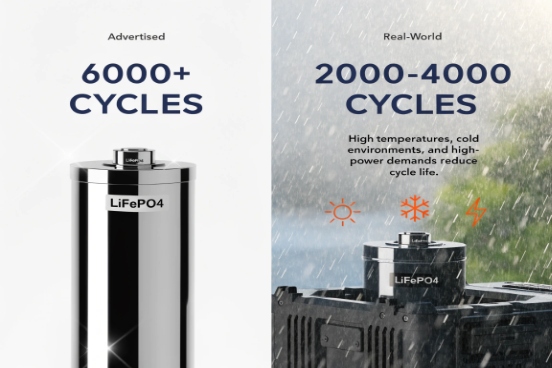
Understanding the true cycle capacity of LiFePO4 cells requires looking beyond marketing numbers. Let's explore what cycle life really means and how to evaluate battery specifications accurately.
What Does "Cycle Life" Mean for a LiFePO4 Battery?
We often encounter confusion about what "cycle life" actually represents. Many users assume it means the battery simply stops working after the rated cycles, which isn't accurate.
Cycle life refers to the number of complete charge-discharge cycles a battery can perform before its capacity drops to a specified percentage of its original capacity, typically 80% or 70%. A cycle counts as one full discharge and recharge, regardless of how many partial charges occur.
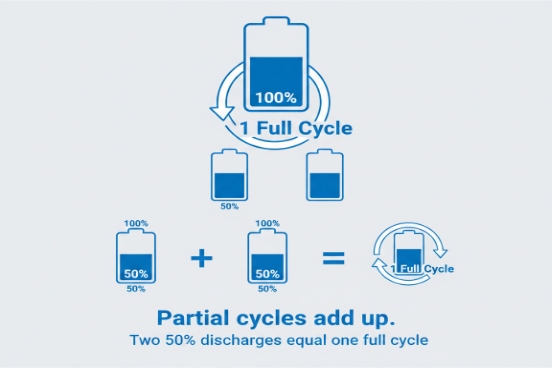
Let's break down the concept of cycle life in practical terms:
Understanding One Cycle
- Full cycle: 0% to 100% and back to 0%
- Partial cycles: Two 50% discharges equal one full cycle
- Cumulative counting: Multiple partial discharges add up
End of Life (EOL) Standards
| EOL Capacity | Meaning | Typical Use Case |
|---|---|---|
| 80% EOL | Retains 80% capacity | Premium applications |
| 70% EOL | Retains 70% capacity | Standard applications |
| 60% EOL | Retains 60% capacity | Budget applications |
Testing Conditions Matter
- Depth of discharge (DoD)
- Charge and discharge rates
- Operating temperature range
- Rest periods between cycles
How Many Cycles Can a 3.2V 100Ah LiFePO4 Cell Really Achieve?
The market is flooded with claims of 6000, 8000, or even 10000 cycles. However, We've learned that these numbers rarely reflect real-world performance without understanding the test conditions.
Under standard test conditions (25°C, 0.5C charge/discharge, 80% DoD, 80% EOL), a quality 3.2V 100Ah LiFePO4 cell achieves 3000-4000 cycles. The advertised 6000+ cycles often come from shallow discharge tests or 70% EOL measurements.
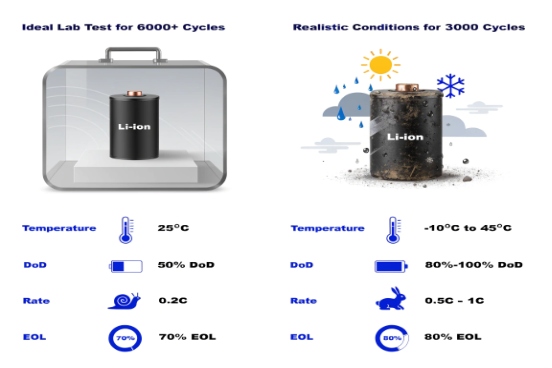
Here's what you need to know about realistic cycle expectations:
Standard Test Conditions
- Temperature: 25°C (77°F)
- Charge rate: 0.5C (50A for 100Ah)
- Discharge rate: 0.5C (50A for 100Ah)
- Depth of discharge: 80%
Real-World Performance
| Test Condition | Advertised Cycles | Realistic Cycles |
|---|---|---|
| Ideal lab (80% DoD) | 6000+ | 3000-4000 |
| Real-world mixed use | 4000-5000 | 2000-3000 |
| Harsh conditions | 3000-4000 | 1500-2500 |
Battery Pack vs Single Cell
When cells are assembled into packs, cycle life typically decreases by 20-30% compared to individual cells. This happens because:
- Cells age at different rates
- Weaker cells limit overall performance
- Additional stress from series/parallel connections
- BMS overhead and protection interventions
What Factors Affect the Cycle Life of LiFePO4 Cells?
Understanding what impacts battery longevity helps you make informed purchasing decisions. Many factors work together to determine actual performance.
The primary factors affecting cycle life are depth of discharge, charge/discharge rates, operating temperature, and cell quality. Each factor can reduce cycle life by 30-50% when operating outside optimal ranges.
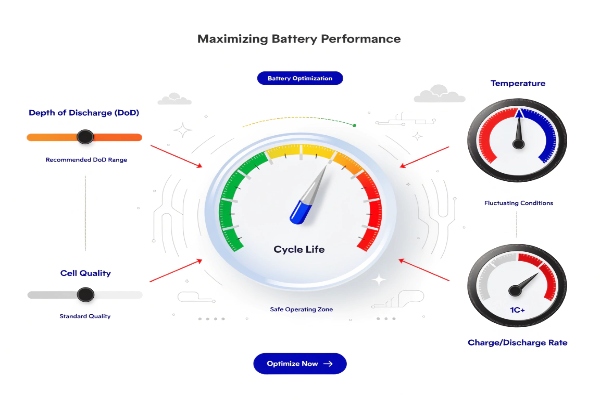
Let's detail how each factor impacts your battery's longevity:
Depth of Discharge Impact
- 100% DoD: 2000-3000 cycles
- 80% DoD: 3000-4000 cycles
- 50% DoD: 5000-7000 cycles
- 30% DoD: 8000+ cycles
Temperature Effects
| Temperature Range | Cycle Life Impact | Performance Notes |
|---|---|---|
| -10°C to 0°C | -40% to -50% | Reduced capacity |
| 0°C to 25°C | Optimal | Best performance |
| 25°C to 45°C | -20% to -30% | Accelerated aging |
| Above 45°C | -50% or more | Risk of damage |
Charge/Discharge Rate Influence
Higher charge and discharge rates create more stress on the cells. A 1C rate might reduce cycle life1 by 20% compared to 0.5C rates. Fast charging (above 1C) can cut cycle life in half.
Quality Variations
Different manufacturers produce cells with varying quality levels. This explains why cells with similar specifications can have 10-15% price differences. Higher quality cells use better materials and tighter manufacturing tolerances.
80% EOL vs 70% EOL: What's the Difference in Cycle Life?
The End of Life specification is critical but often overlooked. This single number can dramatically change cycle life claims and pricing.
The difference between 80% EOL and 70% EOL typically adds 1000-2000 cycles to the rated life. A cell rated for 3000 cycles at 80% EOL might claim 4000-5000 cycles at 70% EOL, using the exact same cell.
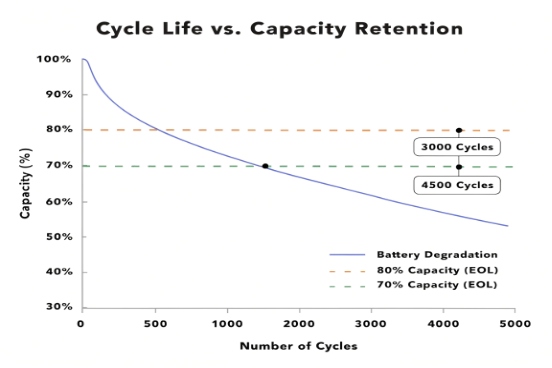
Understanding EOL specifications helps you compare products accurately:
Practical Performance Differences
- 80% EOL: Battery still highly functional
- 70% EOL: Noticeable capacity reduction
- Price impact: 10-15% difference in cost
Marketing Implications
| Specification | Typical Claim | Reality Check |
|---|---|---|
| 3000 cycles @ 80% EOL | Premium quality | Standard performance |
| 4000 cycles @ 70% EOL | Same cell | Marketing adjustment |
| 6000 cycles @ 70% EOL | Exceptional | Check test conditions |
Critical Questions to Ask Suppliers
When comparing cells with similar prices but vastly different cycle claims, always ask:
- What is the EOL percentage?
- What are the exact test conditions?
- What is the depth of discharge?
- What temperature was used?
- What charge/discharge rate?
Price-Performance Analysis
If two suppliers offer similar prices but one claims significantly longer cycle life, be cautious. Quality cells with genuinely longer life should cost 10-15% more. Similar pricing with better specs often indicates different testing standards or lower quality claims.
Conclusion
A typical 3.2V 100Ah LiFePO4 cell realistically delivers 2000-4000 cycles under real-world conditions, despite marketing claims of 6000+. Always verify test conditions and EOL specifications before purchasing to ensure you get true value for your investment.
-
Understanding cycle life is crucial for optimizing battery performance and longevity. ↩