How Does Discharge Rate Affect Battery Life?
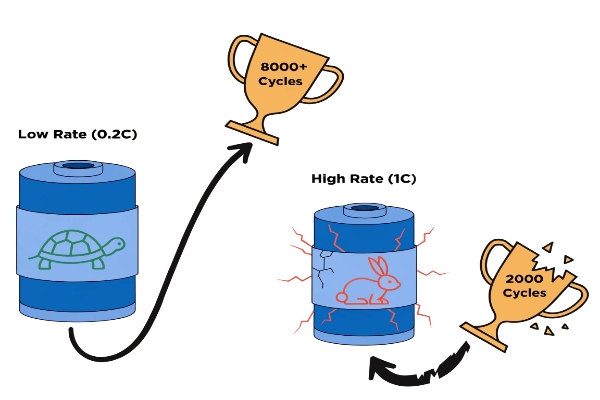
You might notice that two identical batteries can have drastically different lifespans. One dies after 2000 cycles while another reaches 8000 cycles. The secret often lies in how fast you charge and discharge them.
Discharge rate directly impacts battery lifespan through heat generation, polarization effects, and mechanical stress. A battery discharged at 1C may last only 2000-3000 cycles, while the same battery at 0.2C can achieve 6000-8000 cycles.
Understanding how discharge rates affect your battery can help you make smarter choices about system design and usage patterns. Let's explore the science behind this critical relationship.
What is Discharge Rate of Battery?
When we first started working with batteries, the C-rate terminology confused me. Many users struggle with understanding what these numbers actually mean for their applications.
Discharge rate, expressed as C-rate, indicates how quickly a battery releases its stored energy relative to its capacity. A 1C rate means fully discharging a battery in one hour, while 0.5C takes two hours.
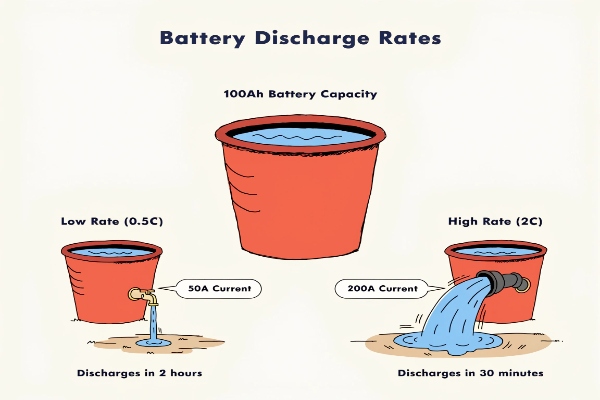
Let's break down C-rates using practical examples:
Understanding C-Rate with a 100Ah Battery
- 0.2C = 20A (5 hours to discharge)
- 0.5C = 50A (2 hours to discharge)
- 1C = 100A (1 hour to discharge)
- 2C = 200A (30 minutes to discharge)
What Higher C-Rates Mean
| Aspect | Low C-Rate (0.2C) | High C-Rate (2C) |
|---|---|---|
| Current | 20A for 100Ah | 200A for 100Ah |
| Discharge time | 5 hours | 30 minutes |
| Cell stress | Minimal | Significant |
| Heat generation | Low | High |
Practical Implications
Higher C-rates create three major challenges:
- Increased current flow through the battery
- Faster energy release demanding more from materials
- Greater internal stress on cell components1
Why Higher C-Rates Reduce Cycle Life?
We've observed that many users don't realize how dramatically discharge rates affect longevity. The relationship isn't linear, making high C-rates far more damaging than most expect.
Higher C-rates accelerate battery degradation through excessive heat generation, polarization effects, lithium plating risk, and mechanical stress on electrodes. These factors combine to reduce cycle life by 50-70% when moving from 0.2C to 1C discharge rates.
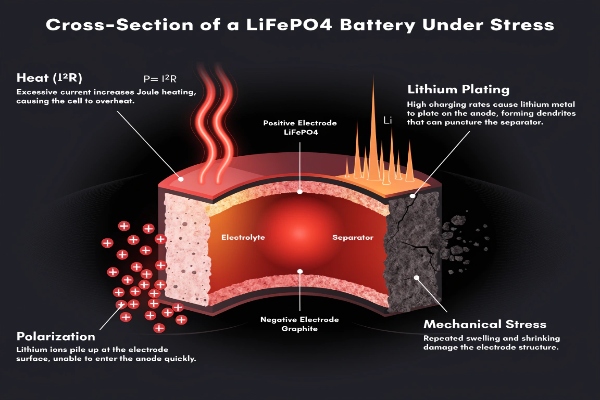
Let's explain the four primary degradation mechanisms in detail:
A. Increased Heat Generation
Every battery contains internal resistance. When current flows, heat generates according to the formula: P = I²R
This means heat increases with the square of current, not linearly.
Heat Generation Example
- 0.2C = 20A current
- 1C = 100A current
- Current increases: 5× (from 20A to 100A)
- Heat generation increases: up to 25× (5² = 25)
Heat-Related Damage
| Problem | Cause | Long-term Effect |
|---|---|---|
| Electrolyte decomposition | High temperature | Reduced ionic conductivity |
| SEI layer growth | Thermal acceleration | Increased resistance |
| Cathode degradation | Material breakdown | Capacity loss |
| Gas generation | Chemical reactions | Cell swelling |
| Lithium plating | Uneven heating | Safety risks |
B. Stronger Polarization Effect
At high current, lithium ions cannot move fast enough through the electrode materials. This creates concentration differences and voltage drops under load.
Polarization Consequences
- Lower usable capacity at high rates
- Higher internal stress during operation
- Earlier voltage cutoff limits
- Accelerated capacity fading over time
C. Lithium Plating Risk
This represents one of the most serious degradation mechanisms during high-rate charging. Under specific conditions, metallic lithium deposits on the anode surface instead of intercalating properly2.
Conditions That Trigger Lithium Plating
- High charging current (above 0.5C)
- Low ambient temperature (below 10°C)
- High state of charge (above 80%)
- Aged batteries with increased resistance
Lithium Plating Damage
| Effect | Impact | Severity |
|---|---|---|
| Capacity loss | Permanent | High |
| Resistance increase | Progressive | Medium |
| Dendrite formation | Structural damage | Critical |
| Short circuit risk | Safety hazard | Extreme |
D. Mechanical Stress on Electrode Materials
During charging and discharging, electrode materials expand and contract. Think of it like repeatedly bending a metal wire. Do it slowly, and the wire tolerates many bends. Do it rapidly, and it breaks quickly.
Mechanical Degradation Process
High C-rates cause:
- Aggressive expansion and contraction cycles
- Increased mechanical fatigue
- Electrode material cracking
- Active material detachment from current collectors
- Conductive network damage
- Progressive capacity fade
Why ESS Batteries Usually Last Longer Than EV Batteries
We've noticed a striking difference in battery longevity between different applications. This difference isn't random but stems from fundamental operational differences.
ESS batteries typically last 2-4 times longer than EV batteries because they operate at lower C-rates (0.2C-0.5C) under stable conditions, while EV batteries experience high discharge rates (1C-3C) and aggressive cycling from acceleration and braking.
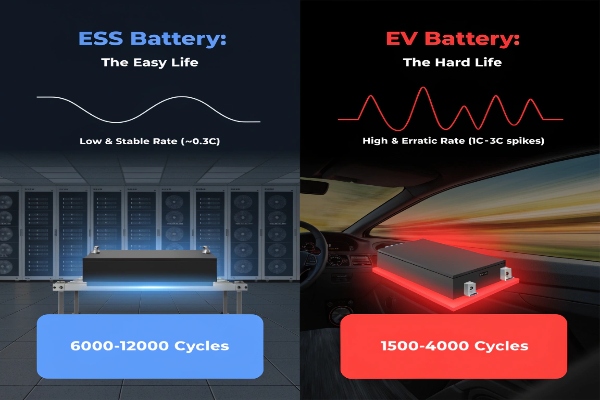
Understanding these differences helps explain why identical cells perform so differently:
Operating Condition Comparison
ESS Battery Environment
- Discharge rates: 0.2C to 0.5C
- Charge rates: 0.2C to 0.5C
- Temperature control: HVAC systems maintain optimal range
- Load profile: Smooth, predictable patterns
- Cycling pattern: Gradual, controlled cycles
EV Battery Environment
- Discharge rates: 1C to 3C during acceleration
- Charge rates: 0.5C to 2C (fast charging)
- Temperature variation: Wide ambient range
- Load profile: Aggressive starts and stops
- Cycling pattern: Frequent, unpredictable demands
Cycle Life Comparison
| Application | Typical C-Rate | Temperature Control | Typical Cycle Life |
|---|---|---|---|
| ESS | 0.2C–0.5C | Excellent | 6000–12000 cycles |
| EV | 1C–3C | Limited | 1500–4000 cycles |
| Power tools | 5C–10C | None | 500–1000 cycles |
Why ESS Batteries Excel
The combination of favorable operating conditions creates a multiplication effect:
- Lower heat generation preserves materials
- Minimal polarization reduces stress
- Reduced lithium plating risk
- Gentler mechanical cycling
- Better thermal management
- More controlled aging process
Real-World Performance Data
From my experience analyzing battery systems, an ESS battery operating at 0.3C can achieve:
- 8000-10000 cycles to 80% capacity
- Minimal capacity fade per cycle
- Predictable degradation patterns
- Lower maintenance requirements
Meanwhile, an EV battery with the same cells might only deliver:
- 2000-3000 cycles to 80% capacity
- Higher capacity fade rate
- Variable degradation patterns
- More frequent capacity checks needed
Design Implications
This explains why:
- ESS systems can use lower-grade cells economically
- EV batteries require premium cells despite shorter life
- ESS projects achieve better ROI over time
- EV battery replacement becomes a significant cost factor
Conclusion
Discharge rate profoundly impacts battery longevity through heat generation, polarization, lithium plating, and mechanical stress. Operating at 0.2C-0.5C instead of 1C-3C can triple cycle life, explaining why ESS batteries consistently outlast EV batteries by 2-4 times.
-
"Lithium-ion battery degradation: Introducing the concept of ... - arXiv", https://arxiv.org/html/2512.15440v1. Peer-reviewed battery literature describes how high-rate charge or discharge can intensify internal gradients, heat generation, and mechanical or electrochemical degradation processes, supporting the general claim that higher C-rates place greater stress on cell components. Evidence role: mechanism; source type: paper. Supports: Higher C-rates can create greater internal stress on battery cell components.. Scope note: The support is contextual because the type and severity of stress depend on battery chemistry, cell geometry, temperature, and operating conditions. ↩
-
"Lithium Ion Battery Anode Aging Mechanisms - PMC - NIH", https://pmc.ncbi.nlm.nih.gov/articles/PMC5452304/. Electrochemical battery literature describes lithium plating as the deposition of metallic lithium on the negative electrode surface when lithium-ion intercalation into the anode is kinetically or thermodynamically limited. Evidence role: definition; source type: paper. Supports: Under specific conditions, metallic lithium deposits on the anode surface instead of intercalating properly.. Scope note: The source would define the plating mechanism; additional experimental evidence would be needed to establish that it occurred in a specific battery or test condition. ↩